
Empty cart
Oh no! It appears your cart is empty. Add some almonds to your daily regime with the Treehouse products.
All Blog PostsNews

A technical guide for formulators and sourcing teams on almond oil by any name — composition, food and personal care applications, grade specifications, and supplier requirements.
In this article, we cover: why badam oil and almond oil share two names; the full nutritional and chemical profile of the oil; its key applications in food formulation and personal care; sourcing and grade considerations; and how the “badam” positioning is used in product development and marketing.
If you have encountered the term “badam oil” in supplier catalogs, cosmetic formulations, or food ingredient lists and wondered whether it differs from almond oil, the answer is straightforward: it does not. The two names refer to the same ingredient.
The word “badam” (बादाम in Hindi, بادام in Urdu and Persian) simply means almond. It is used across South Asia, the Middle East, and parts of Central Asia as the everyday term for the nut and, by extension, for the oil derived from it. As global supply chains and ingredient sourcing have become increasingly interconnected, the term has carried over into international trade and product development contexts, particularly in markets with strong South Asian consumer bases or suppliers.
For buyers, formulators, and product developers, recognizing that badam oil and almond oil are interchangeable names is essential for accurate sourcing, specification matching, and regulatory compliance, especially when working across markets that use different terminology for the same raw material.
Badam oil is extracted from the kernels of the sweet almond, Prunus dulcis. It is distinct from bitter almond oil, which is derived from a different variety and is not used in food or leave-on cosmetic applications due to the presence of compounds that require processing to render safe.
Sweet almond oil is produced through two main methods:
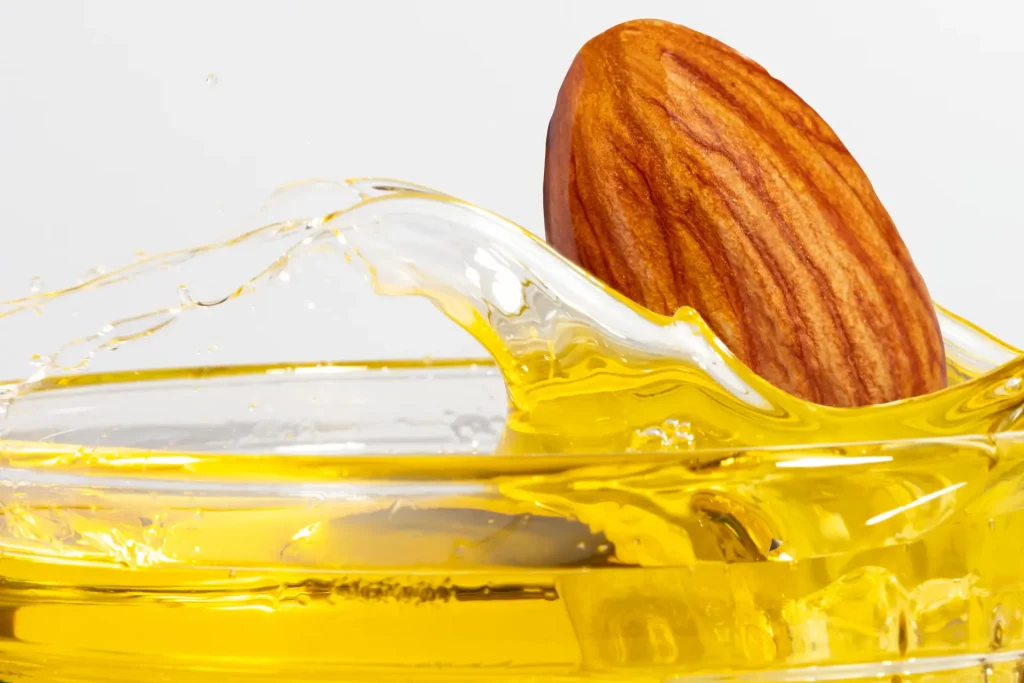
The resulting oil is pale yellow, with a mild flavor and a high concentration of monounsaturated fatty acids, primarily oleic acid (omega-9), alongside linoleic acid (omega-6) and a range of fat-soluble vitamins and phytosterols.
Understanding the composition of badam oil helps explain why it performs so consistently across both food and personal care applications.
| Component | Approximate content |
|---|---|
| Oleic acid (omega-9) | 62-86% |
| Linoleic acid (omega-6) | 14-30% |
| Palmitic acid (saturated) | 4-9% |
| Vitamin E (tocopherols) | 47-80 mg per 100g |
| Phytosterols | 90-250 mg per 100g |
The resulting oil is pale yellow, with a mild flavor and a high concentration of monounsaturated fatty acids, primarily oleic acid (omega-9), alongside linoleic acid (omega-6) and a range of fat-soluble vitamins and phytosterols.
Understanding the composition of badam oil helps explain why it performs so consistently across both food and personal care applications. Font: https://pmc.ncbi.nlm.nih.gov/articles/PMC7520497/
This fatty acid profile makes badam oil exceptionally stable compared to oils with higher polyunsaturated fat content, while also giving it the skin-compatible emollient properties that have made it a longstanding ingredient in personal care formulations.
In the food industry, almond oil is valued for its mild flavor, oxidative stability, and nutritional positioning. Key applications include:
From a regulatory standpoint, sweet almond oil used in food is recognized as safe across major markets, including the US (FDA GRAS status) and the EU (listed as a novel food ingredient under specific conditions or as a traditional ingredient depending on the application, per EU Novel Food Catalogue).
The personal care industry has used almond oil for centuries, and its relevance in modern formulation remains strong. It appears in a wide range of product categories:
In INCI nomenclature (the international standard for cosmetic ingredient labeling), badam oil and almond oil are both listed as Prunus Amygdalus Dulcis Oil, which confirms that regardless of the commercial or regional name used, they refer to the same ingredient from the same botanical source.
While badam oil and almond oil are the same ingredient, buyers should be aware that quality specifications differ depending on the intended application.
| Specification | Food grade | Cosmetic grade |
|---|---|---|
| Purity | High, food safety certified | High, often pharmacopoeia-grade |
| Refining | Cold-pressed or refined | Cold-pressed preferred |
| Peroxide value | Strictly controlled | Strictly controlled |
| Color and aroma | Mild, controlled | Neutral to mild |
| Certifications | FSSC 22000, organic (if applicable) | ISO 22716 GMP, ECOCERT (if organic) |
| Traceability | Full supply chain documentation | Full supply chain documentation |
For formulators working across both food and personal care applications, working with a supplier who can provide documentation for both end uses simplifies procurement and ensures consistent quality standards.
Beyond the technical and regulatory dimensions, the term “badam oil” carries cultural weight that product developers can use intentionally. In South Asian beauty and wellness traditions, badam oil has been associated with hair strength, skin nourishment, and overall vitality for generations. Brands targeting South Asian consumers, or those looking to connect with Ayurveda-inspired positioning, often choose to use “badam oil” as the primary name on-pack rather than “almond oil.”
This is a legitimate and effective branding decision, provided the underlying ingredient specification and labeling comply with applicable regulations in the target market. In most markets, the INCI declaration on cosmetic products must still read “Prunus Amygdalus Dulcis Oil” regardless of what name is used in the product title or marketing copy.
Is badam oil the same as sweet almond oil? Yes. Badam oil and sweet almond oil are the same ingredient. “Badam” is simply the word for almond in Hindi, Urdu, and Persian, so both names refer to the oil extracted from the kernels of Prunus dulcis. The composition, fatty acid profile, and applications are identical regardless of which name appears on the label or specification sheet.
Can badam oil be used in food applications? Yes. Sweet almond oil has GRAS (Generally Recognized as Safe) status with the FDA and is used in a range of food applications, including finishing oils, bakery and confectionery, specialty nutrition, and flavor encapsulation. Food-grade badam oil must be sourced from a certified food-safe facility and accompanied by appropriate documentation such as a certificate of analysis and FSSC 22000 certification.
What is the INCI name for badam oil? The correct INCI name is Prunus Amygdalus Dulcis Oil. This applies regardless of whether the ingredient is marketed as badam oil, almond oil, or sweet almond oil. Any cosmetic product sold in regulated markets must use this INCI declaration on the ingredient list.
Is badam oil always cold-pressed? Not necessarily. Badam oil can be produced through cold pressing, expeller pressing, or solvent extraction depending on the intended application and volume requirements. Cold-pressed badam oil is preferred for premium cosmetic and food applications due to better retention of the oil’s natural fatty acid profile and sensory characteristics. Industrial applications where yield is the priority may use expeller or solvent-based extraction.
Whether your formulation calls for badam oil or almond oil, the sourcing decision starts in the same place: a reliable supplier with the quality controls, certifications, and traceability to support both food and personal care applications.
Treehouse Almonds supplies high-quality almond-derived ingredients to manufacturers across food, nutrition, and personal care sectors. If you are developing a formulation that requires almond oil or sourcing badam oil at industrial scale, our team can support your specification requirements, provide full traceability documentation, and discuss supply options that match your volume and quality needs. Reach out to start the conversation.
Click here to contact us directly and request your specification sheet.
Be in the loop for vital news about the California almond market.
Enjoy 10% off when you order 6 or more